
Studying law is not only about reading statutes, understanding judgments, and remembering legal principles. A successful lawyer must also know how to think on their feet, present an argument, communicate clearly, question effectively, and respond confidently under pressure.
This is why practical learning is so important in legal education.
Law schools conduct moot courts, mock trials, client counselling sessions, legal debates, seminars, guest lectures, presentations, and other activities to give students exposure to real-world legal practice. But there is one important question:
What happens after the activity is over?
Students participate, receive feedback, and move on to the next activity. Often, they do not get an opportunity to watch their own performance again and analyse what they did well, where they struggled, and how they can improve.
This is where Classifyr can make a significant difference.
Classifyr: Turning Legal Practice into a Continuous Learning Experience
Classifyr is a Lecture Capture Solution that enables educational institutions to record, manage, and deliver classroom and practical learning content. It can capture video, audio and presentation content and make it available to students for secure, on-demand access.
For a law school, this means that learning does not have to end when the class or moot court session ends.
- A student's performance can become a learning resource.
- A moot court can become a revision tool.
- A guest lecture can become a permanent academic resource.
- And a classroom discussion can become something students can revisit whenever they need it.
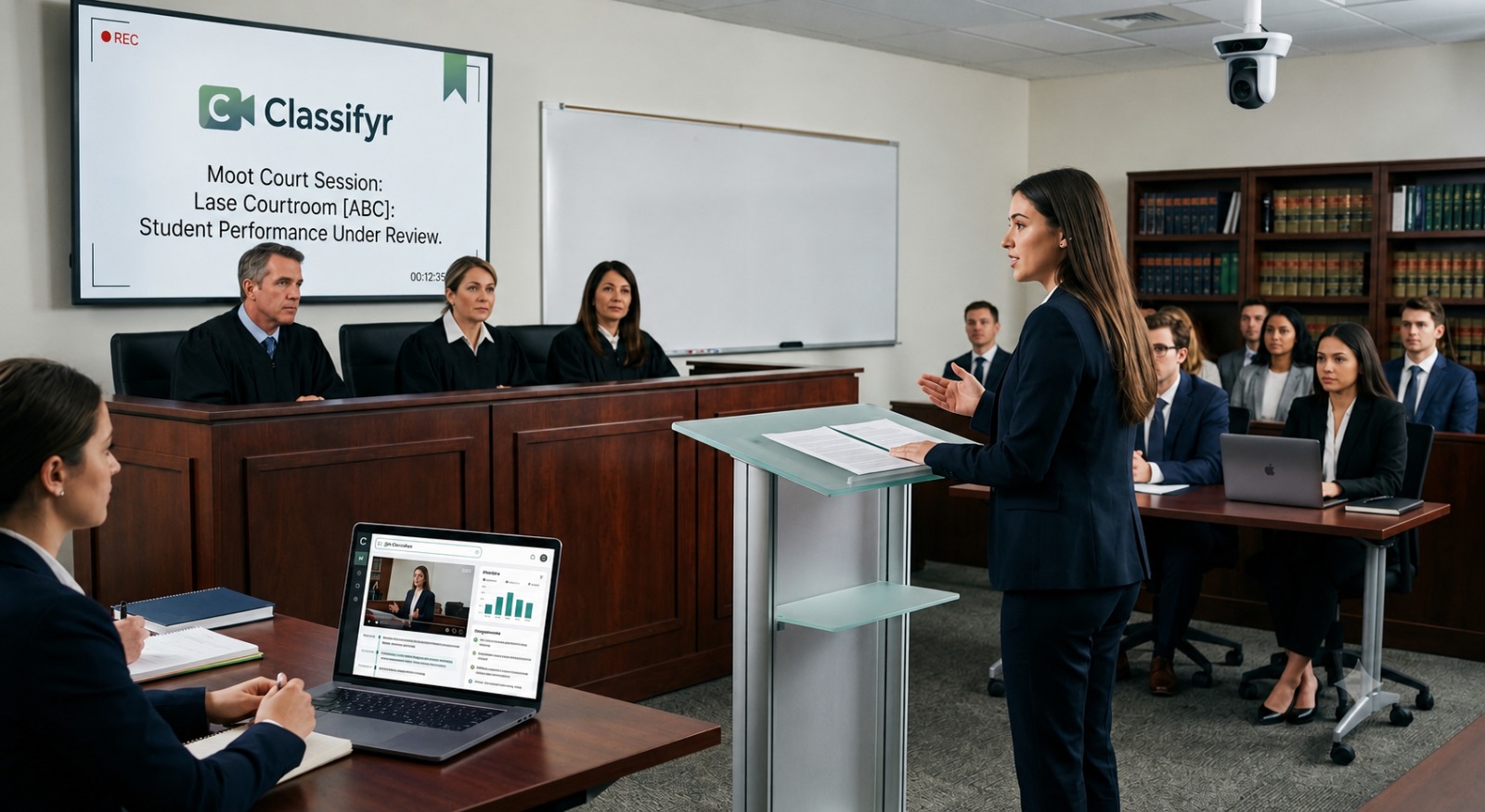
1. Record Moot Court Performances
Moot court is one of the best ways for law students to experience advocacy in a controlled academic environment.
Students research legal issues, prepare arguments, present their submissions and respond to questions. These activities help develop skills that cannot be learned simply by reading a textbook.
With Classifyr, a law school can record these sessions and allow students to watch their performance afterwards.
A student can review:
- How clearly did I present my argument?
- Did I maintain confidence while speaking?
- How did I respond to questions?
- Was my body language appropriate?
- Did I structure my arguments properly?
- Did I make effective use of authorities and evidence?
- Where did I lose clarity or confidence?
Instead of simply hearing that they need to “improve their advocacy,” students can see and understand their own performance.
That makes feedback far more practical and meaningful.
2. Make Feedback More Powerful
Feedback is one of the most important parts of professional education.
But feedback given several days after a performance can sometimes feel abstract. A student may remember what they were trying to do, but not exactly what happened during the performance.
Recorded sessions change this.
Faculty members can refer to specific portions of a recording while providing feedback. Students can then revisit that moment and understand exactly what they need to improve.
This creates a simple learning cycle:
Perform → Record → Review → Receive Feedback → Improve → Perform Again
Classifyr can help make this cycle a regular part of legal education.
3. Help Students Learn from Each Other
Learning does not always have to come from a professor.
Law students can learn a great deal by observing how their classmates approach the same legal problem.
Imagine a class where five students participate in a moot court.
Instead of only the participants learning from the exercise, the entire class can potentially benefit from the recorded sessions.
Students can observe:
- Different approaches to legal arguments
- Different styles of advocacy
- Effective questioning techniques
- Strong and weak presentations
- Different ways of responding to judges
- How evidence and authorities are presented
This creates a shared library of practical legal learning.
4. Capture Mock Trials and Practical Legal Exercises
The value of Classifyr goes beyond moot courts.
Law schools regularly conduct practical activities such as:
Mock Trials | Client Counselling | Negotiation Exercises | Legal Debates | Mediation Sessions | Mock Interviews | Legal Aid Activities | Court Visits | Seminars | Workshops
Recording these activities creates a digital repository of practical learning.
Students can revisit these sessions before examinations, competitions, internships or placements.
This is particularly useful because practical legal skills improve through observation, practice and repetition.
5. Record Guest Lectures from Lawyers and Judges
Law students benefit enormously from hearing directly from practicing advocates, judges, corporate lawyers, legal consultants and other professionals.
However, guest lectures are often one-time events.
A student who misses the session may never get the opportunity to hear it.
With Classifyr, institutions can record important guest lectures and make them available to authorised students through their digital learning environment. Classifyr supports on-demand access and can integrate with institutional LMS environments.
This can help law schools gradually build their own Digital Legal Knowledge Library.
Imagine a student being able to access:
“Constitutional Law – Expert Lecture”
“Corporate Law – Industry Session”
“Criminal Law – Advocate's Perspective”
“How to Prepare for Litigation – Senior Counsel”
“Career Opportunities in Law – Alumni Session”
These recordings can continue providing value long after the original event.
6. Help Students Revise Difficult Legal Concepts
Law students deal with a large volume of information.
They may understand a concept during a lecture but struggle to remember it during examination preparation.
Recorded lectures allow students to revisit difficult topics at their own pace.
With Classifyr, students can go back to a lecture, replay important sections and revise concepts when required. The platform also offers features such as AI-driven keyword search and captioning that can make recorded content easier to navigate.
For example, instead of watching an entire two-hour lecture again, a student may be able to locate the relevant portion discussing a particular legal concept or case.
This makes revision more efficient
7. Bring the Classroom and Courtroom Closer Together
One of the biggest challenges in legal education is connecting theory with practice.
Students may know the law but still need to develop the confidence and communication skills required to use that knowledge effectively.
Classifyr can help law schools bring practical activities into the learning process by making real classroom performances and academic exercises available for review.
The classroom becomes more than a place where students listen to lectures.
It becomes a place where they can:
Learn → Practise → Perform → Review → Improve
That is much closer to how professional skills are actually developed.
8. Build a Digital Repository for the Law School
Over time, a university can build a valuable collection of its academic and practical activities.
This could include:
- Recorded lectures
- Moot court competitions
- Mock trials
- Faculty presentations
- Guest lectures
- Legal workshops
- Student presentations
- Seminars and conferences
- Alumni interactions
- Faculty development programmes
Instead of these activities disappearing after they are conducted, they become part of the institution's digital academic repository.
Classifyr provides tools for recording, managing and distributing this content while supporting secure access and institutional LMS integration.
9. Support Faculty in Understanding Student Engagement
Classifyr can also provide institutions with engagement and viewing insights.
This can help faculty and academic administrators understand how students are using recorded learning content and which resources receive greater engagement.
For a law school, this can support better academic planning.
Faculty can identify which topics students repeatedly revisit and where additional classroom explanation or support may be useful.
10. Create Better Learning Opportunities for Absent Students
Students may sometimes miss lectures because of competitions, internships, court visits, university activities or other academic commitments.
A missed class should not necessarily mean missed learning.
Recorded lectures provide students with an opportunity to catch up with academic content when they are unable to attend physically. Classifyr is designed to support both classroom and hybrid learning environments.
This becomes particularly valuable for law students who may have academic activities taking place outside the traditional classroom.
The Bigger Opportunity for Law Schools
The future of legal education is not about replacing classroom teaching with technology.
It is about using technology to make classroom teaching more valuable.
A moot court should not end when the arguments are over.
A guest lecture should not disappear when the speaker leaves.
A classroom discussion should not be lost after the lecture ends.
And student feedback should not remain only in the memory of the student or faculty member.
With Classifyr, these experiences can be recorded, revisited, analysed and reused.
This creates a more continuous learning environment where students can learn not only from their teachers, but also from their own performances and from the experiences of their peers.
From Learning Law to Learning How to Practise Law
The ultimate goal of a law school is not simply to produce students who know the law.
It is to prepare students who can apply the law with confidence, communicate effectively and perform professionally.
Classifyr can help law schools take an important step in that direction.
By capturing lectures, moot courts, mock trials, guest sessions and practical activities, Classifyr can help transform these experiences from one-time academic events into long-term learning resources.
Because the best learning doesn't have to end when the class ends.
Classifyr for Law Schools
Record. Manage. Revisit. Learn. Improve.
Turn every lecture, moot court, practical exercise and expert session into an opportunity for continuous learning with Classifyr.